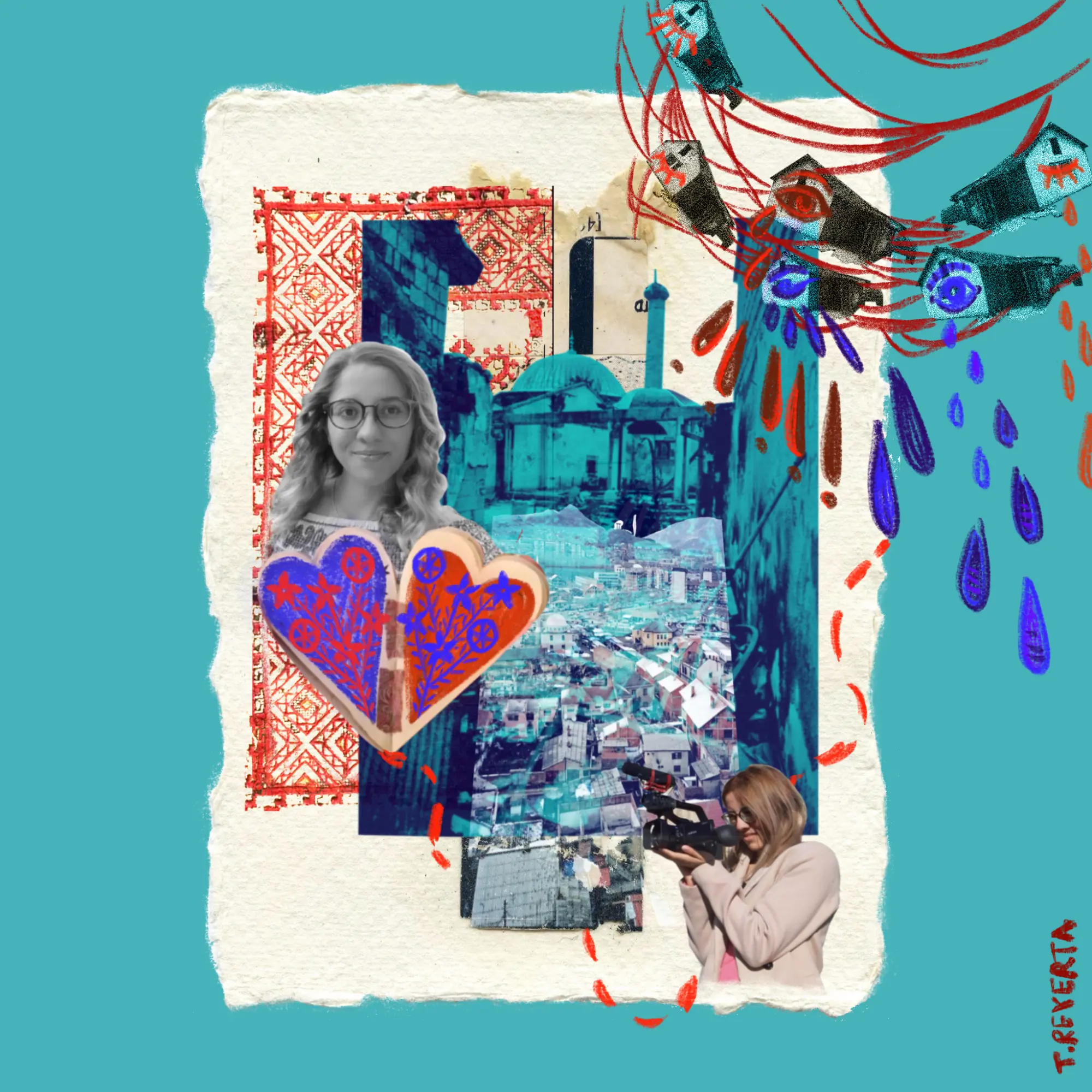
Đuli Ramadani’s intellectual and activist journey is inseparable from the personal and historical experiences that have shaped her life. Born in Kosovo, she grew up in Novi Sad, Serbia, after her family was forced to flee the war in 1999. Years later, her work with Romani communities displaced by the same conflict would lead her to explore how the consequences of war continue to shape people’s lives, but also how communities find ways to resist exclusion and build better futures.
Today, Đuli brings these questions into her work as a Romani feminist, researcher, documentary filmmaker, and community practitioner. She is also a member of the Dalan Fund’s Resource Distribution Committee (RDC) of the Romani Program, where she works alongside other Romani women activists to direct resources toward grassroots, intersectional Romani organizing across Central and Eastern Europe.
Born in Kosovo, Grew Up in Serbia
Đuli is a social anthropologist and Romani feminist from Serbia. She grew up in Novi Sad in an ethnically mixed neighborhood, playing with kids mostly from the Serbian, Hungarian and Roma communities. As she was 11, she realized how female protagonists were significantly less represented in the assigned books within the school curricula. In her free time, she loved to read, especially fantasy books with main female characters.
Throughout her school years, several of her teachers left a lasting, positive impact on her. However, her education pathway was not free from discrimination. At times, teachers underestimated her abilities, or discouraged her from continuing her studies. As she explains, prejudices and discrimination towards Romani children put them in a mold, shaping their educational paths and structurally limiting the educational opportunities available to them.
Đuli had always wanted to pursue university, although few women around her had the opportunity to pursue higher education. Her mother was prevented from completing high school, while her older sister, who went on to university, became an important role model. Interested in working with people and supporting others, she decided to study psychology at the University of Novi Sad.
Đuli comes from a Muslim Romani community and was born in Pristina in 1997. Her family fled Kosovo in 1999 and settled in Novi Sad, the second largest city in Serbia. Although Đuli herself has no personal memories from the war, it has profoundly shaped her family’s trajectory and affected her identity. “My family had to start their lives from scratch in a new environment. These experiences of displacement and years after demanded a lot of resilience from them. Observing how they handled new struggles also shaped me to a certain extent.” says Đuli.
Kosovo had enjoyed substantial autonomy within Yugoslavia until 1989, when new amendments in the Serbian constitutions were imposed under Milosevic’s regime, stripping the province of Kosovo of its autonomy. These constitutional amendments triggered a wave of repressive policies, among others the end of Albanian-language teaching in public schools. In the aftermath of these measures, Đuli’s mothers high school was shut down.
Roma experienced war time abuse from both sides, while their suffering was intensified by NATOs 1999 bombing of Yugoslavia (European Roma Rights Centre, 1999). Đuli’s family eventually settled in Novi Sad, finding temporary refuge in Veliki Rit, an informal settlement that expanded significantly as Roma displaced from Kosovo arrived. Over the years, some families settled permanently in Veliki Rit, and the settlement became home to several generations of Roma displaced from Kosovo.
Her personal connection together with her working experience with Romani communities in Veliki Rit, shaped some of the questions Đuli would later pursue through her studies.
Informal Settlement Veliki Rit at the Core of Her Studies and Work
Đuli completed her bachelor’s degree in psychology at the University of Novi Sad. While still a student, she started supporting Romani communities in her hometown. First, as a volunteer helping young people find jobs or job training programs, then as a social mediator within a local project implemented by the NGO “Forum Roma Serbia”. As a social mediator, she facilitated communication between people in need and other professionals or state institutions.
Most of the people she worked with had been displaced from Kosovo and have been living in an informal settlement Veliki Rit, which, as she says, is “an experience that has shaped these people’s life trajectories, and you can see how the consequences of war are still present today.”
Residents in the informal settlement Veliki Rit, many of whom still hold the status of internally displaced persons, cannot register their residential address where they actually live. Other possibilities, for example registering their addresses by the Social Work Center, are in practice limited. Without a residential address, they are prevented from accessing a substantial number of social and health services in the city, and in general from enacting their citizenship rights.
After earning her BA, Đuli learned about the Roma Graduate Preparation Program at Central European University (CEU) and moved to Budapest to enroll. The experience opened up an entirely new intellectual and political horizon. For the first time, she had the space to critically examine the conditions shaping Roma communities’ lives, connecting experiences of marginalization and exclusion to broader social and political structures.
“That was one of the most transformative experiences for me, and it changed me to the core. It was really a space for critical thinking and reflection as well as to connect with the international community,” she says.
She went on to pursue a master’s degree in Sociology and Social Anthropology at Central European University (CEU), seeking to move beyond individual experiences to understand the wider structures of inequality shaping Romani communities’ lives. Her interest in urban sociology brought her back to questions rooted in her own experience of Veliki Rit: how structural inequalities shape informal settlements, but also how these spaces become sites of collective resistance, political participation and community organizing.
Life Stuck in ‘Permanent Temporariness’
Her master’s thesis brought Đuli back to Veliki Rit, where she examines how urban informality is governed. She points out how urban planning becomes a tool city authorities use to ‘tolerate’ the situation on the ground and eventually confine the settlement’s residents. For more than two decades, families have invested in building their homes on state-owned land, yet those homes remain under the constant threat of demolition. The city’s urban plan designates the land for public buildings, preventing residents from legalizing their homes or having a meaningful say in the settlement’s future.
Đuli’s research shows how this informality creates a form of confinement that extends beyond physical space. The uncertainty surrounding residents’ homes also shapes their sense of time, their social and emotional lives, and their ability to imagine and plan for the future. Her analysis further shows how gender shapes these experiences, with Romani women navigating the constraints of informality in different ways.
Yet Đuli is careful not to portray residents solely through the constraints they face. Even amid prolonged uncertainty, she saw people actively working to build better lives for themselves and their families.
Based on ethnographic research, she indicates how many women are undertaking different strategies to provide a bit more than something for the future of their children and improve their livelihoods. They also often demonstrate a profound concern for their children’s education and future prospects. All this occurs in the settlement where inhabitants are largely exposed to territorial stigmatization, eviction threats, as well as job insecurity and labor exploitation.
One research stream increasingly highlights the parallels between the lived realities of citizens who reside in informal settlements and those of stateless refugees. Đuli draws on the concept of ‘permanent temporariness’ (Pasquetti and Picker, 2015), used to describe refugee camps established as temporary spaces that, over time, become enduring and effectively long-term, permanent camps, whereas various state and non-state ruling agencies perpetuate such conditions. Applying this lens to Veliki Rit, Đuli writes in her thesis. “They are trapped in a state of ‘permanent temporariness’, with limited opportunities for physical and social mobility.”
Wanting to contribute to the community beyond the research for her master’s thesis, Đuli shot a short documentary film, “Veliki Rit bb”. The film follows Esmeralda, a Roma woman during her high-risk pregnancy. Living as an internally displaced person with her family in Veliki Rit and without a registered address in Novi Sad, she faced significant hurdles trying to access health insurance. Told through the personal story, this documentary unpacks the structural nature of the problem. The documentary film was supported by the Rekonstrukcija Ženski Fond (RŽF), the first local feminist fund in Serbia.
From Theory to Practice
Three years after completing her studies at CEU, Đuli is now pursuing a second master’s degree in Clinical Social Work at the University of Applied Sciences in Vienna. Building on her academic research and earlier community work, she hopes to deepen and blend her theoretical knowledge and practical experience.
Her interests remain at the intersection of urban, gender and health inequalities. While urban research often focuses on the structures that shape people’s lives, Đuli is equally interested in what people do within those structures: how they navigate, challenge and transform them through collective action. She is particularly interested in bottom-up initiatives, from art collectives to community spaces, and how they help shape European cities.
Supporting bottom-up initiatives, smaller organizations and grassroots collectives is what Đuli finds particularly meaningful about her role on the Resource Distribution Committee (RDC) of Dalan Fund’s Romani Program. Through the Committee, she helps direct resources to Roma-led groups that often face significant funding barriers. Resources intended to support Romani communities often still flow through larger or non-Roma organizations, leaving grassroots Roma-led initiatives with short-term, project-based funding and persistent organizational precarity.
The funding ecosystem needs to better integrate an intersectional perspective. In her view, the Dalan Fund is spearheading alternative infrastructure to support intersectional regional movements.
Đuli finds it important to take into account spatial inequalities within the countries and cities: “We need to pay attention to the spatial inequalities, because women and queer people in urban disadvantaged or rural areas often have far fewer resources. Bringing in these perspectives and making sure the most marginalized voices and communities are represented and supported is important for me,” she explains.
Đuli is equally interested in strengthening connections between Roma-led initiatives across the region. Beyond supporting individual organizations, she sees value in creating opportunities for communities to exchange experiences, learn from one another and develop collective responses to shared challenges.
Her commitment to learning and community engagement extends beyond the RDC. Alongside her studies in Vienna, she contributes to the Invisible University for Ukraine, a CEU initiative supporting Ukrainian students affected by the war. She is also building connections with Romani communities in Vienna, including women with migration backgrounds.
Across these different roles, Đuli continues to explore not only how structural inequalities shape and constrain Romani people’s lives, but also how communities navigate and challenge these conditions, and how their efforts to organise and build more secure futures can be supported through greater access to resources, knowledge and opportunities for collective action.