At the heart of Dalan Fund’s mission to transform how movements and under-resourced communities are funded sits a program dedicated to Romani organizing in Central and Eastern Europe. Grounded in the lived experiences of Romani women, this initiative aims to shift power and recognition toward Romani women and gender-diverse people, ensuring that their knowledge, leadership, and political visions inform and shape social transformation across the region. Challenging and reshaping dominant narratives about Romani people and unpacking the complexities of their perception are central to this work.
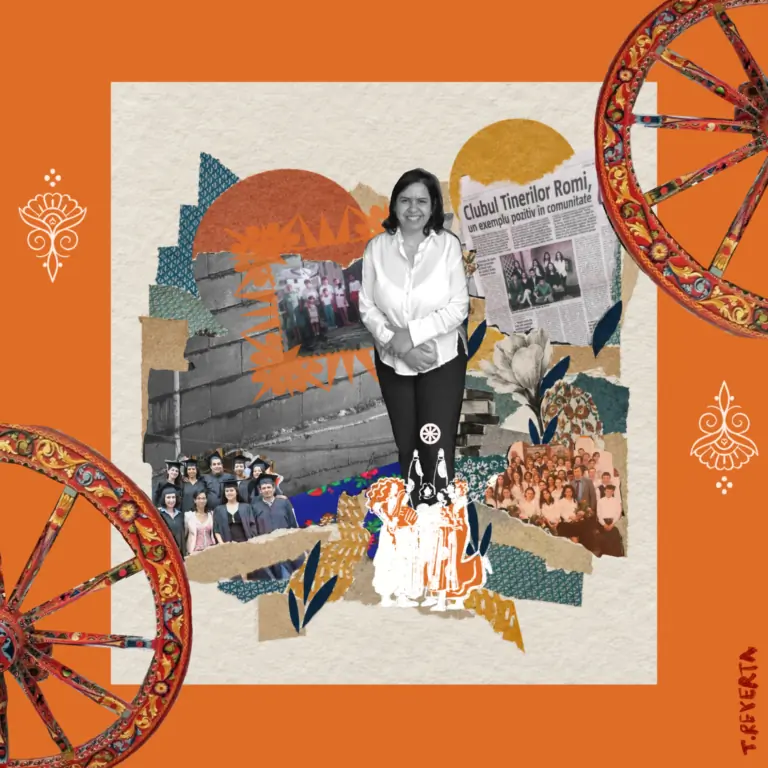
Through this series of profile stories, we want to amplify the individual voices of activists whose everyday work centers on Romani women’s voices, rights, and leadership. This story features Tímea Markócs-Mezei, a teacher and PhD researcher who actively advocates for reducing educational inequalities and supporting the development of inclusive learning environments for Romani youth. In parallel, she has been deeply engaged in the sexual and reproductive health and rights (SRHR) of Romani women.
Tímea is also a member of the Resource Distribution Committee (RDC) of the Romani Program at the Dalan Fund. As one of five Romani women activists from Hungary, Poland, Romania, Slovakia, and Serbia, she holds decision-making power in selecting movement partners that advance intersectional Romani organizing across Central and Eastern Europe.
The Impact of Silence and Stigma at Home and in Schools

When Tímea Markócs-Mezei became a mother in 2021, she was an elementary school teacher in Makó, Hungary, pursuing her doctoral studies, but had not yet earned her PhD. The birth of her daughter was also the moment she, as a Romani woman, experienced firsthand what discrimination by healthcare professionals felt like.
“Later, when I returned to the same hospital, with my academic title (PhD in Education) appearing before my name, the difference in how people spoke to me was striking,” recalls Tímea.
Witnessing and sharing the experiences of others in her community drove her to advocate for the sexual and reproductive health and rights (SRHR) of Romani women and youth, transforming lived experience into a professional mission and an act of resistance.
Romani people are the largest ethnic minority in Europe, including in Hungary, with approximately 700,000 Roma (7.05% of the population) living in the country and around 10 to 12 million across Europe.
It is also one of the most socially and economically marginalized groups. In Hungary, Romani women and girls face systemic health inequalities, having almost no access to sexual and reproductive health (SRH) services and information.
For Tímea, these problems are not abstract; they are everyday realities that shape Romani women’s lives. Currently working as a full-time Physical Education teacher at a primary school in Makó and engaging with students daily, Tímea observes that menstruation, contraception, sexual violence, and emotional well-being are issues that no one discusses at home. In Romani communities she works with, topics related to sexuality and reproduction are veiled in silence, shame, and stigma. These experiences unfold within a broader Hungarian context marked by restricted access to comprehensive sexuality education, persistent stigma surrounding sexuality, and traditional gender norms, where fear of judgment often silences conversations about sexuality and sexual and reproductive health.
“Many of the taboos established by previous generations need to be broken. Young people should be prepared for the changes that happen in their bodies, and they should know what their rights are,” says Tímea.
She sees that the situation in schools is no different in this regard. Young girls often do not feel safe asking questions about their bodies in classrooms. Moreover, teachers, who lack training to provide inclusive education, affect girls’ confidence and choices, reinforcing the marginalization of their bodies.
“Unfortunately, I have heard teachers’ comments like, ‘She’ll only end up having children,’ or ‘She’ll probably have a baby at fifteen,” says Tímea, adding that these attitudes reflect the broader negative stereotypes that continue to shape perceptions of Roma people, especially when it concerns sexuality and reproduction.
This marginalization has cascading effects: students fall behind in their schoolwork, struggle with everyday decisions, and face increased risk of unintended pregnancies and health problems. The consequences of no guidance, both from family and educational institutions, are serious, long-lasting, and, Tímea argues, most vivid in marginalized Romani communities, where poverty, discrimination, and institutional inequalities worsen these disadvantages.
Bodies and Knowledge: A Teacher and Researcher’s Dual Perspective
Tímea personally knows from her student years how decisive motivation can be for educational success, as she struggled with it herself. That experience led Tímea to examine the issue academically. Her PhD research at the University of Szeged examines teachers’ beliefs and attitudes in relation to goal orientation theory, and in her current research she focuses on the future orientation and value preferences of youth.
Moving between the classroom and the university gives her a dual perspective, allowing her to see the interconnections between bodies and knowledge. It also helps to identify institutional gaps and to advocate for policies that center Romani women’s dignity, rights, and self-determination.
“I feel the human consequences of stigma and exclusion. My goal is to make invisible voices heard, break the silence, and advance real change reflecting the actual needs of the community,” she says.
Tímea is convinced that comprehensive sexual education in public schools should reach both girls and boys.
“I think it is important for boys to learn about topics such as menstruation and other aspects of reproductive health. Some discussions could be separated, while others could take place together. The key point is that young people should have opportunities to ask questions openly”, says Tímea.
Under the current legal framework, Hungarian schools are required to invite the school nurse to provide information sessions on these topics. But according to Tímea, these sessions often rely on outdated methods, and even basic student questions are met with surprise or discomfort.
Another issue is the lack of continuity. Tímea notices that a single session once a year is not enough.
She believes that feminist pedagogy can foster open and critical discussions about gender equality, bodily autonomy, and sexuality in schools and enable girls to speak freely about their experiences, concerns, and needs.
Institutional Discrimination in Health Care
Beyond receiving almost no knowledge about sexual and reproductive health and rights at home and in schools, Romani girls and women encounter significant barriers when seeking care around childbirth, contraception, or abortion. These barriers are rooted in institutional racism and sexism.
As a result, it creates alarming differences in sexual and reproductive health between Romani communities and the general population. According to the UNFPA, in Eastern Europe, almost half of young Romani women are married before the age of 18, and nearly one in three becomes pregnant while still in adolescence.
Tímea is also vocal about the way healthcare institutions often treat Romani women, with suspicion and neglect, rather than with dignity and respect. In many cases, communication from medical staff is not clear or understandable for patients, and women are not always provided the necessary information to give truly informed consent, limiting their ability to exercise their rights.
“Early motherhood, lack of sexual education, histories of forced sterilization, and reproductive control are not isolated problems,” she argues.
“They are closely intertwined with racism and sexism, often reinforcing one another. Insufficient information increases the risk of unintended pregnancies, while early motherhood limits young women’s opportunities in education, the labor market, and social mobility”, she says.
Where Institutions Fail, Communities and Civil Society Actors Step In
When formal institutions fail to provide adequate care or reliable information on sexuality and reproductive rights, Tímea notices that the gap is often filled by family members, especially mothers and sisters, alongside peers, teachers, community workers, and civil society organizations. These support networks not only provide information but also offer emotional and practical support, helping young people and community members navigate their reproductive rights and address questions about their bodies in the absence of institutional support.
Roma-led civil society organizations and initiatives, including, among others, Muri Phen, SZIROM Women’s Circle, Community Roma Doula Service of Emma Association, Roma for Development Association, and the MARA program of Romaversitas Foundation, all play a crucial role in addressing the gaps left by the Hungarian state and formal institutions in supporting the sexual and reproductive health and rights (SRHR) of Romani women. The Community Roma Doula Service provides trust-based support to Romani women throughout their interactions with reproductive healthcare and medical services, while other initiatives create spaces for mutual learning, community-building, and collective reflection around sexual and reproductive health and rights (SRHR). Despite the essential role these organizations play, they continue to face chronic underfunding and remain sidelined within dominant SRHR narratives, policymaking, and funding spaces. Roma rights remain among the most neglected in the broader ecosystem of philanthropy. Only 3% of global human rights philanthropy reaches the CEECCNA regions, and within that picture, Roma rights stand out for their marginalization. And although Romani organizing is deeply intersectional, the existing funding remains quite siloed.
Within these already constrained resources, sexual and reproductive health and rights of Romani women are frequently missing from funding agendas, even though the birth rates and educational attainment of Romani communities – particularly Romani girls and women – remain a recurring focus of policy reports, demographic statistics, census analyses, and political discourse. Yet the structural conditions shaping these outcomes receive far less attention. Those making decisions about resource allocations tend to favor approaches perceived as less politically contested and more readily fundable, such as education, employment, or infrastructure, leaving initiatives that address the intersections of gender, ethnicity, and reproductive justice chronically under-resourced.
“The gap often remains invisible to both the communities themselves and decision-makers,” says Tímea. “This invisibility contributes to systemic shortages in services, despite the significant needs of communities.”
Funding Dignity, not Control
Tímea is clear about what needs to change in how SRHR is funded: instead of charity and demographic control, funding must center on the perspectives of dignity and justice. Her experience in the Romani RDC further shaped her approach to grantmaking. Throughout the application review and selection process, she sought to prioritize organizations that are deeply rooted in Romani communities and responsive to local needs. She also paid particular attention to initiatives that provide long-term support to Roma women and youth, as well as organizations that are often overlooked by funders due to political marginalization, limited resources, or because they are newly established or operate informally.
“Funding that is participatory and sensitive to local cultural contexts can help normalize open dialogue about sexuality, bodily autonomy, and trauma,” she says. “In this context, SRHR would not function as a tool of control but as a systemic, rights-based support that strengthens the dignity and agency of the community.” Only long-term support and integration of diverse resources, she adds, can ensure the sustainability of Roma SRHR-focused programs and enable continuous responsiveness to community needs.
Achieving fundamental change, however, will also require, according to the Romani activist, deep political reforms, the development of legal frameworks that protect reproductive rights, and a change in narrative. SRHR programs, Tímea suggests, need to actively involve Romani men by building their awareness of women’s rights, bodily autonomy, and reproductive health issues. This, too, would help shift community norms, making open, non-judgmental conversations about sexuality more accepted socially and culturally.
“Romani women will be able to achieve genuine autonomy and freedom over their lives only through a rights-based, justice-oriented approach by philanthropy and by dismantling patriarchal and discriminatory barriers,” concludes Tímea Markócs-Mezei.