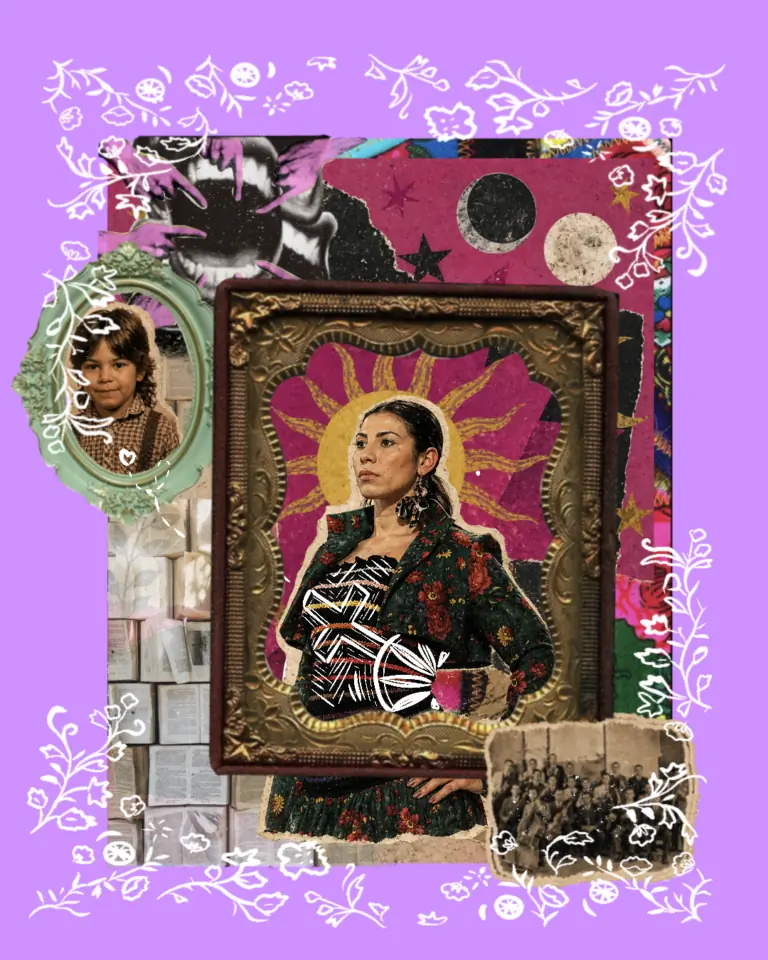
At Dalan, we spotlight individuals whose everyday work advances Romani women’s voices, rights, and leadership. This story features Simona Torotcoi, a Romani scholar and activist from Romania who draws critical attention to structural inequalities affecting Romani communities while advocating intersectional, justice-oriented approaches in both policy and global human rights arenas.
Simona is one of five members of the Dalan Fund’s Romani Program Resource Distribution Committee, where, alongside other Romani women activists, she helps select movement partners across Central and Eastern Europe. The program itself challenges dominant narratives about Romani people, shifts power and recognition toward Romani women and gender-diverse people, and ensures their knowledge, leadership, and political visions shape social transformation across the region.
The profile story of another Romani RDC member, Tímea Markócs-Mezei, is available here.
Growing Up in Transylvania
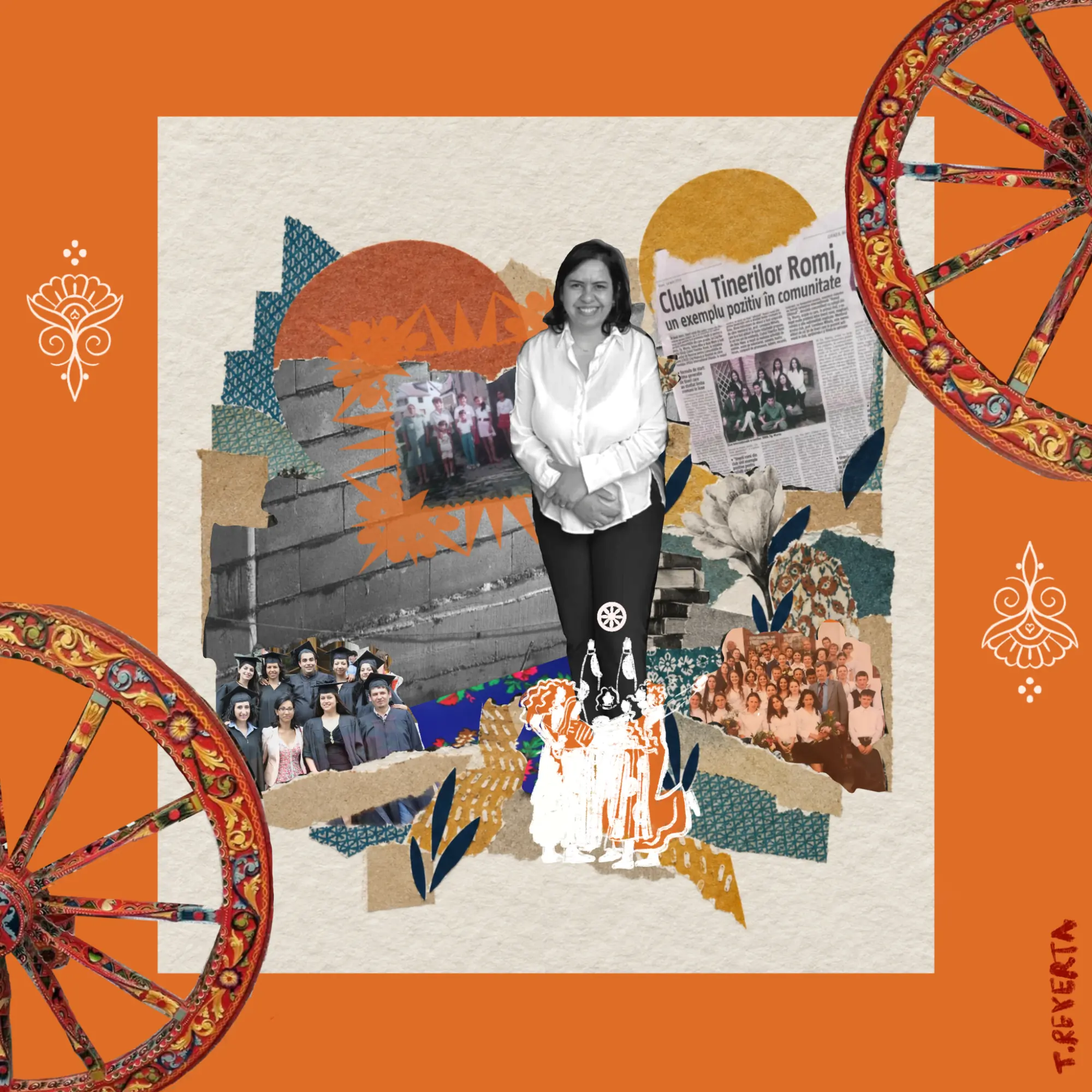
Simona grew up in a Transylvanian village where Romanian, Hungarian and Romani communities lived together. Yet, as is still common across Europe today, Romani families lived on the outskirts, away from what she calls the “mainstream” part of the village. Simona’s parents crossed this divide in the 1980s, moving into a house left behind by a departing Saxon family, while many of her relatives remained in the Roma neighborhoods. Simona moved between these worlds, playing with Romanian children around her home and spending time with her extended family in the Roma community.
For many Romani children, school teaches the stigma of being a Roma long before it teaches them anything about Romani history. In Simona’s school, teachers’ references to people from “that neighborhood” served as shorthand for bad behavior. Coming from a village also marked a social difference, and educational achievement became, in part, a way of proving that she was “as good as the Romanian students”.
At the same time, her relationships with other Roma students exposed her to different ways of inhabiting Roma identity and shaped how she negotiated her own. She particularly remembers one Roma girl who was widely read, critical, outspoken and exceptionally intelligent. “That relationship helped me recognize that there was nothing about my identity of which I should be ashamed,” she says.
It was only at university that Simona learned more about Romani history and movement – subjects largely absent from education in Romania and across Europe – and began developing her own political voice.
“Let Us Do Something Together" – The Beginnings of Political Organizing in Baia Mare
Simona studied languages and pedagogy at university in Baia Mare city, hoping to become a teacher one day. In Baia Mare, Romania’s industrial and touristic hub, many Romani residents’ lives were shaped by profound inequalities. Around 2008-2009, Romani families lived across several segregated or informal settlements with inadequate housing and infrastructure, compounded by insecure tenure and the threat of eviction. For Simona and a small group of other Romani university students, this became the context in which they began to informally organize.
“Our thinking was simply: ‘Let us do something together,’” Simona remembers. Drawing on their university studies, they organized educational and artistic activities for Romani children in Baia Mare. They organized a Romani-language course and began learning about Romani history, activists and the wider movement, while also discovering how much their own education had left out.
They were “educating each other” through small projects on Roma history and movement, and as she puts it, “it feels strange that I was already in my twenties when I began properly learning about my own history and my own people.”
In 2011, the municipality of Baia Mare erected a concrete wall along the Horea Street housing complex, whose residents were predominantly Roma. The formal justification was that children entering the main road were in danger from its traffic; however, as Simona puts it, “the actual issue was aesthetics”. The conditions behind the wall were severe, with inadequate waste collection, unsafe improvised electricity, and poor access to water.
“The authorities, instead of improving the Roma community’s living conditions, made those conditions less visible. “
Moving beyond their earlier community-based activism, it forced a more difficult political reckoning over how to engage with a local authority that was itself responsible for the discrimination they sought to challenge. A few years later, “as time passed and they became more mature and their work became more political,” they organized the “Wall-Free Europe” campaign together with ERGO Network, bringing further international media attention to the case.
International Roma and human rights organizations and the Romanian equality body later condemned the wall as discriminatory and recommended its demolition, but it remained standing for a decade. In 2024, after years of legal challenges, a final court ruling ordered the municipality to demolish it.
From The Classroom to Academia – Turning Education Into a Question of Access and Inequality
After finishing university, Simona still expected to become a teacher. She took the state examination required to teach in Romania, but she failed. This was when she heard about the Romani Graduate Preparation Program at Central European University in Budapest, without yet knowing where this opportunity might lead her. There, she met enthusiastic professors and Roma students, and gained access to knowledge about Roma history and movement that she had never had before.
The Program was designed to prepare Romani graduates for further academic study, combining intensive academic and language training with exposure to various fields, including gender studies, nationalism studies, social anthropology, and public policy. For Simona, this meant encountering new ways of approaching questions she was already interested in. She gravitated towards public policy, aiming to engage with education policy.
Just as important was the community the Program created. “There were many Roma students from different countries and backgrounds. We learned about the similarities between us and the specific cultural characteristics and traditions of our respective communities. That experience connected us strongly and transformed my Roma identity,” says Simona.
Education was gradually taking on a broader meaning in Simona’s work. Being part of this cohort also drew her attention to the limited presence of Roma in higher education and to the social and institutional pathways that shaped whether Romani students reached university at all. “I wanted to improve Roma access to education, particularly higher education,” she says. What had once been the profession she imagined for herself became a way of examining how institutions shape access and exclusion.
Her research expanded from Roma access to higher education to the representation of Roma in textbooks and Romani children’s experiences of discrimination in schools. Her PhD examined inclusion and quality in higher education, situating Roma within broader European debates about the social dimension of universities.
From Representation to Power – Bringing Roma Voices to The Global Agenda
Academia gradually became a future she could imagine, particularly as her PhD opened opportunities to teach, first as an assistant at CEU and later during a one-year teaching fellowship at Bard College.
COVID and her move to North Macedonia interrupted that path. Her experience revealed how fragile academic careers can be – even with a CEU PhD and teaching experience, her applications did not translate into a stable position. Academia remained part of her work, but no longer in its center.
Instead, her work shifted towards international human-rights advocacy. At the Global Forum of Communities Discriminated on Work and Descent, Simona works to place Roma rights within global debates on gender equality, environmental racism and access to water, while creating routes for Roma to participate in these debates directly. She coordinates the Rights Experts Program, which prepares young people to engage with international human-rights mechanisms; eleven of its thirteen current participants are women, including three Romani women.
For Simona, representation in these institutions cannot stop at discussing Roma rights; Roma must also be present in the processes shaping them. “Whenever these spaces are available, we try to bring Romani women to the table,” she says. Shortly before our conversation, she had returned from Geneva with two other Romani women, where they briefed a UN committee on the human-rights situation of Roma, particularly Romani women, in their respective countries.
Yet these spaces are not equally accessible, and for Simona, it is a central concern. In European work on race and discrimination in particular, Roma perspectives remain underrepresented. Participation requires resources, and international advocacy can feel distant from the immediate realities of Romani communities. As she notes, “people with lived experience should be able to contribute directly to the processes in which policies and standards affecting their communities are shaped.”
Its effects are also rarely immediate. “International advocacy is a long process. Developing or influencing a norm at the UN level can take years before it has any visible effect on communities. Donors often want to see immediate and tangible impact, while our work operates through long-term institutional change,” says Simona. Since last year’s US funding cuts, mobilizing resources has become more difficult. However, whenever possible, she continues to do her best to ensure that Roma women’s perspectives and voices are heard and reflected.
Simona believes that Roma women should not only be the subjects of funding, but active decision-makers in shaping priorities. She sees Dalan Fund’s Romani Program as a model for other funding schemes to meaningfully include Roma in decision-making and in determining how funds are allocated and distributed.
“Roma need to enter the arenas where decisions are made. People with lived experience should not only contribute from outside, but they should also occupy positions of institutional power,” she says.
This is also beginning to inform how Simona thinks about her own future. She still wants to create something for Romani students, perhaps a program or scholarship, and the possibility of returning to academia remains. At the same time, she has begun to consider whether she might one day take on a position of greater institutional power, perhaps even in politics.